| NASA Is Trying to Rescue a Sinking Space Telescope Before It's Too Late |
|
June 30, 2026
NASA Is Trying to Rescue a Sinking Space Telescope Before It's Too Late
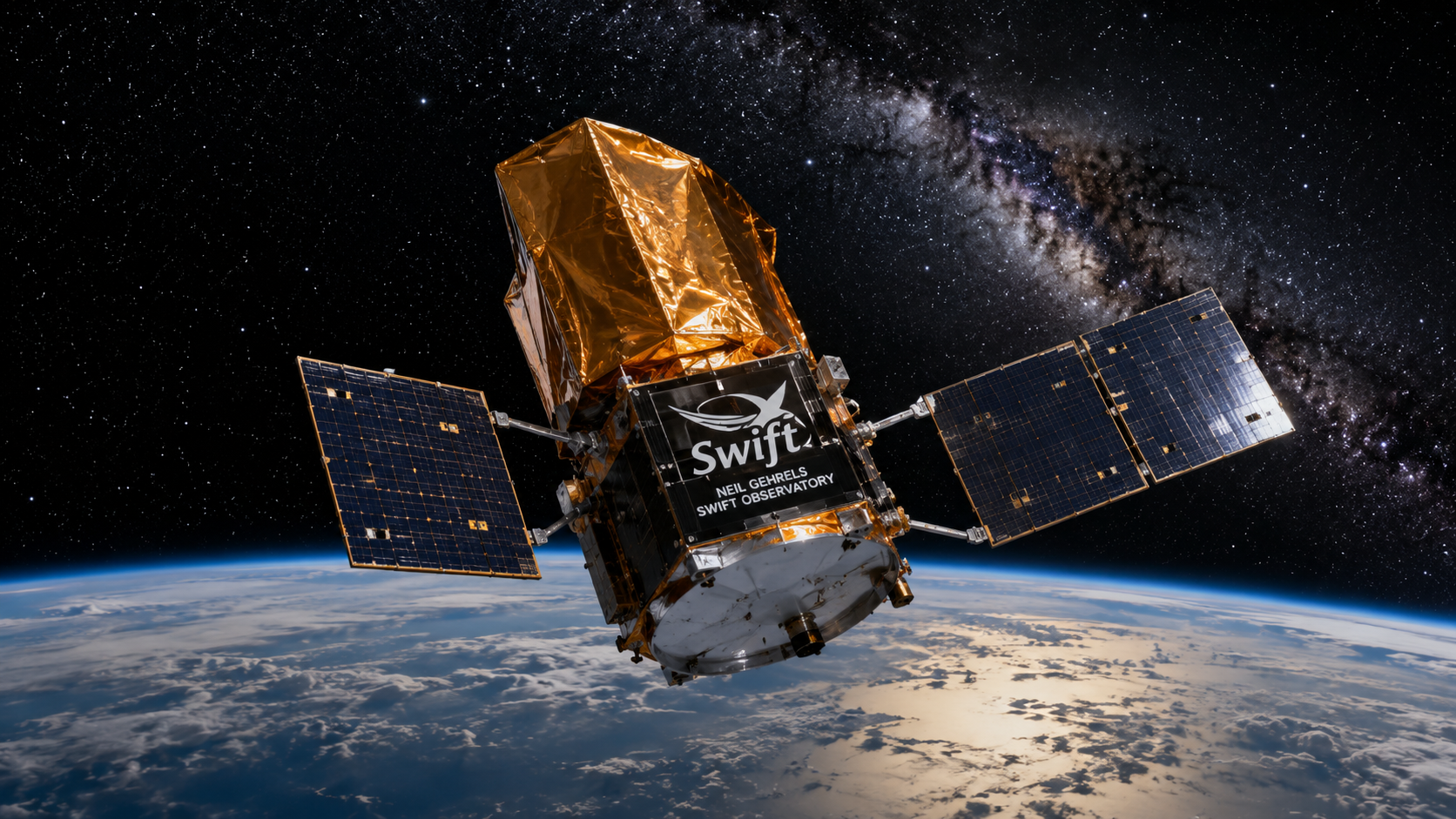
After spending more than 20 years unlocking some of the universe's biggest mysteries, one of NASA's most successful space telescopes is in trouble. Now, the agency is attempting something that's rarely been done before: sending a spacecraft into orbit to rescue it. The Neil Gehrels Swift Observatory, launched in 2004, has spent decades studying gamma-ray bursts—the incredibly powerful explosions created when massive stars collapse into black holes or when ultra-dense neutron stars collide. These cosmic blasts are among the most energetic events ever observed, and Swift has helped scientists better understand how the universe works. But now the telescope itself is running out of time. Why Swift Is Falling Toward Earth Like every satellite in low-Earth orbit, Swift gradually loses altitude because of atmospheric drag. Normally, that happens very slowly, but an unusually active sun has sped up the process. During the recent solar maximum—the peak of the sun's 11-year activity cycle—increased solar storms heated Earth's upper atmosphere, causing it to expand. That thicker atmosphere creates more drag on satellites like Swift, pulling them closer to Earth much faster than expected. NASA predicts the telescope's orbit could drop below a critical altitude of about 185 miles above Earth as early as October. If that happens, Swift would eventually re-enter the atmosphere and burn up. NASA's Rescue Mission Rather than letting the observatory fall, NASA is giving it a second chance. The agency awarded a $30 million contract to Arizona-based Katalyst Space Technologies to develop a robotic spacecraft called LINK, while Northrop Grumman is providing the launch system. The mission is scheduled to launch no earlier than Wednesday after weather delayed the original attempt. Here's how it will work:
If successful, the mission could significantly extend Swift's operational life. More Than Just Saving One Satellite NASA officials say this mission is about much more than preserving a single observatory. Swift was never designed to be serviced in space. It has no onboard engines capable of raising its own orbit or docking with another spacecraft. If LINK succeeds, it could prove that older satellites can be repaired, repositioned, upgraded, or extended—even if they weren't originally built for servicing. That could dramatically change the future of satellite operations. According to Penn State astronomy professor John Nousek, restoring a spacecraft that originally cost around $300 millionto build for just $30 million is an incredible value compared to launching an entirely new mission. A Telescope That Has Already Changed Astronomy Swift's original mission was only expected to last two years. Instead, it has spent more than two decades making groundbreaking discoveries. The observatory has studied more than 1,400 gamma-ray bursts, including the most distant one ever detected—an explosion from a star roughly 13 billion light-years away, giving scientists a glimpse into the early universe. Those discoveries have made Swift one of NASA's most productive space observatories. A Big Test for the Future of Space Exploration Successfully catching and moving a free-flying satellite is no easy task. Engineers acknowledge that orbital rendezvous remains one of the most technically challenging operations in spaceflight. Still, NASA and Katalyst believe they're ready. If the mission succeeds, it won't just save Swift—it could open the door to a future where satellites are routinely repaired, upgraded, and reused instead of being discarded when their fuel runs out or their orbits begin to decay. For NASA, rescuing Swift isn't just about preserving a telescope. It's about proving that the next era of space exploration may include fixing spacecraft instead of replacing them. Posted by Johnny Ice at 10:36 AM |