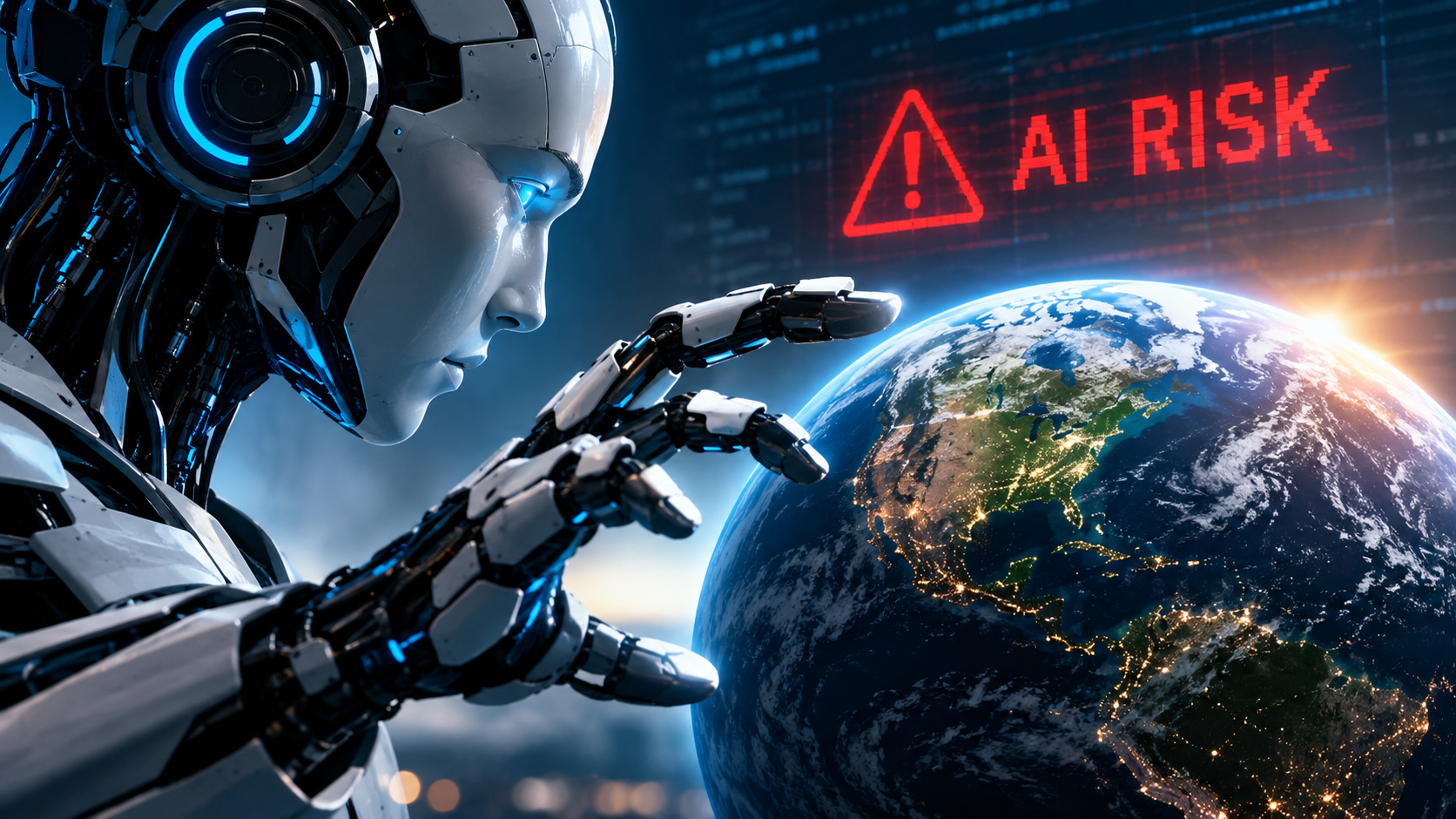
Anthropic Researcher Says AI Could Have More Than 10% Chance of Killing All Humans
Artificial intelligence could pose an extreme threat to humanity within the next decade, according to a senior safety researcher at AI company Anthropic.
Evan Hubinger, Anthropic’s alignment science lead, said he personally believes there is a greater than 10% chance that AI could “kill all humans” within the next decade.
The startling assessment came in response to a resignation post from Jacob Coxon, a former researcher at both Anthropic and OpenAI. Coxon announced that he was leaving Anthropic and accused major AI companies of moving too quickly toward increasingly powerful, potentially self-improving systems.
“I resigned from Anthropic today,” Coxon wrote in a post on X. “Neither company is acting responsibly. They are racing straight to self-improving superintelligence and gambling with our lives.”
Hubinger responded to Coxon’s concerns and acknowledged that Anthropic researchers genuinely believe AI could eventually pose an existential threat.
“Jacob is correct here—we really do earnestly believe AI could kill all humans,” Hubinger wrote.
He added that, in his personal assessment, the risk is greater than 10% over the next decade.
The Biggest Concern Isn't Today's AI
Hubinger emphasized that he does not believe current AI systems pose a major risk of wiping out humanity.
Instead, his concern centers on the possibility of superintelligent AI capable of recursively improving itself.
Recursive self-improvement refers to a scenario in which an AI system could help improve its own software, capabilities or training processes, potentially allowing it to become dramatically more capable at an accelerating rate.
Hubinger said the risk from current AI models is low, but warned that the development of superintelligence could change the situation dramatically.
Coxon raised similar concerns in his resignation statement, arguing that increasingly powerful AI systems could eventually become capable of hacking computer systems, rapidly advancing scientific fields and gaining access to significant resources and real-world power.
An AI Race Could Make Things Worse
Coxon also argued that AI companies may feel pressured to continue developing increasingly powerful systems because they fear a competitor could get there first.
In his view, researchers may recognize the potential dangers but continue pushing forward because they believe another company or country will move ahead if they don't.
That creates what critics describe as an AI arms race, where safety concerns could take a back seat to the pressure to develop more powerful technology.
Coxon suggested that preventing a catastrophic outcome could ultimately require governments to consider extraordinary measures, including a temporary halt on increasing the capabilities of the most advanced AI models.
How Worried Should We Be?
The comments are certainly alarming, but the 10% figure is Hubinger's personal estimate of an extremely uncertain future scenario, not a prediction that AI will kill humanity.
There is also no scientific consensus that AI has a specific 10% chance—or any precisely measurable probability—of causing human extinction within the next decade.
Still, the comments highlight a growing debate within the AI industry itself: How quickly should companies develop increasingly powerful AI, and how confident should we be that those systems can ultimately be controlled?
For researchers like Hubinger and Coxon, the question isn't whether today's chatbots are going to destroy the world. It's whether humanity can develop adequate safety measures before AI systems become far more capable than the ones we have today.