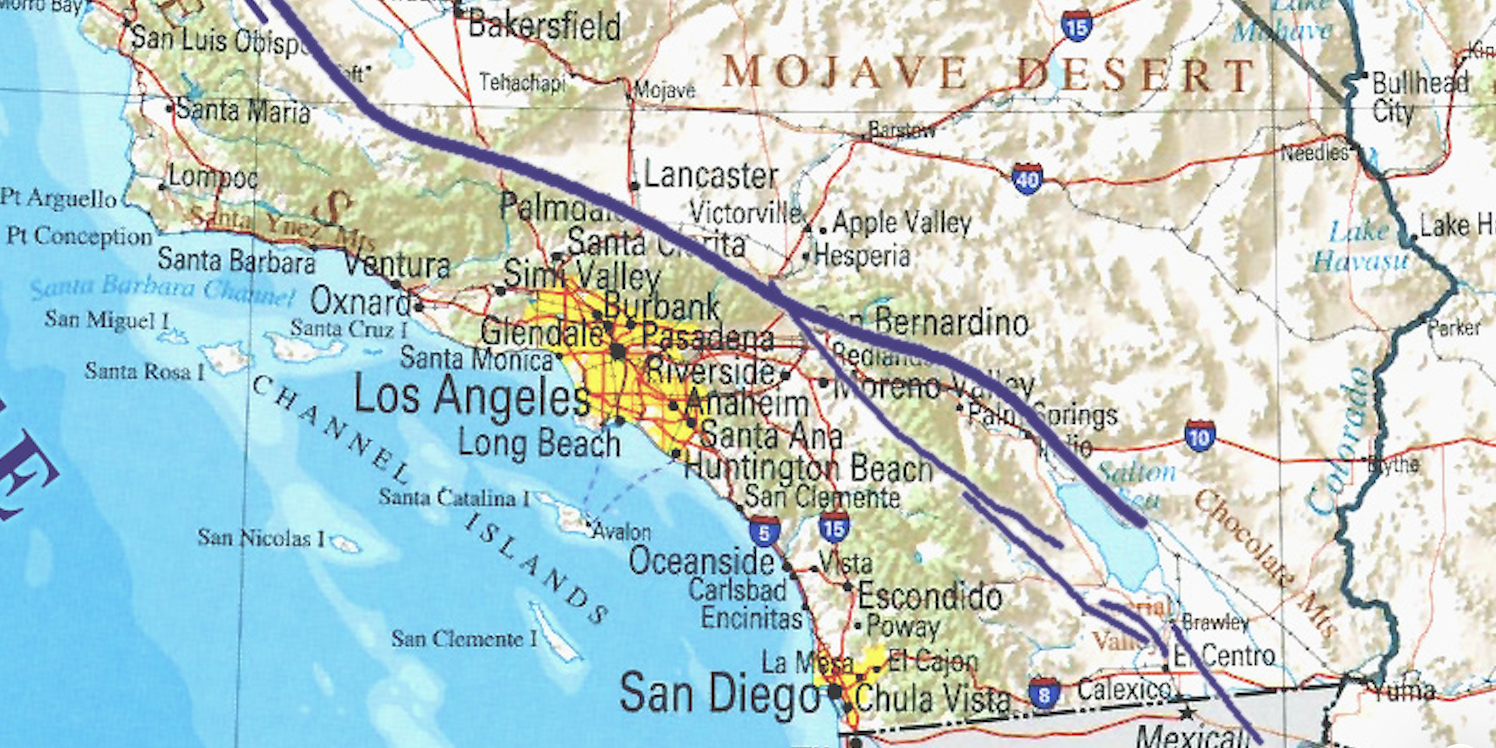
 Image Credit: GeologyHub on YouTube
Stress Along California's San Andreas Fault Reaches Highest Levels in 1,000 Years, Study Finds
A new study is raising fresh concerns about California's earthquake risk, revealing that stress levels along the San Andreas Fault and the San Jacinto Fault Zone have reached their highest point in the last 1,000 years.
Researchers from the University of Hawaii at Manoa say the fault systems are now in what they describe as a "critically loaded state," meaning the pressure that is typically released through major earthquakes has continued to build over time. It's been roughly 160 years since the region experienced its last major rupture, and scientists say that stored energy may be reaching unprecedented levels.
The findings, recently published in the Journal of Geophysical Research: Solid Earth, suggest that several segments of these fault systems are now carrying more stress than at any other point over the past millennium.
"Our results show that stress levels on multiple fault segments are now at or above the highest values seen in the past millennium and that the region may be capable of a large through-going rupture involving both fault systems," said lead author Liliane Burkhard.
One area of particular interest is the Cajon Pass in Southern California. Researchers describe it as a possible "earthquake gate" that could determine whether the San Andreas Fault and San Jacinto Fault Zone rupture separately or together during a major seismic event.
In some scenarios, the Cajon Pass may help prevent a combined rupture. In others, it could actually allow both fault systems to break simultaneously. According to the study, a joint rupture would likely be far more destructive, potentially impacting millions of people across Los Angeles, San Bernardino, Riverside, and the Coachella Valley.
"The conditions that determine whether the 'earthquake gate' at Cajon Pass opens or stays closed appear to be related to how closely the stress levels on the two fault systems are aligned with each other at the time of rupture," Burkhard explained.
To conduct the research, scientists analyzed 1,000 years of earthquake history using sophisticated computer models. They reconstructed the region's seismic past through geological evidence, including radiocarbon dating of displaced sediments and tree-ring records.
Despite the alarming findings, researchers emphasize that this is not a prediction that a major earthquake is imminent.
"This is not a prediction of when an earthquake will happen," Burkhard said. "What we can say is that the system is critically stressed, and that physics-based models like this one give us a clearer picture of the range of scenarios we should be prepared for."
The study's authors say the research can help improve hazard assessments, guide infrastructure planning, and strengthen emergency preparedness efforts.
For Californians, the message remains the same: be prepared. State officials continue to encourage residents to have emergency plans, build disaster supply kits, and know what to do before, during, and after an earthquake.
As California waits for its next major seismic event, scientists continue working to better understand the forces building beneath our feet. While no one can predict exactly when "The Big One" will strike, experts agree that preparation today could make all the difference tomorrow.